Airwallex: Ultimate 2026 Guide
What's the actual cost of moving money internationally for your business? Most business owners don't know the full number because it hides in exchange rate markups, wire transfer fees, and correspondent bank charges that never show up as a single line item. Airwallex was built to expose and eliminate that cost. It's a global financial infrastructure platform — multi-currency accounts, cross-border payments, FX, corporate cards, and expense management — designed for businesses that operate across borders. It is not accounting software, and it doesn't try to be. It pairs with your accounting stack. Explore Airwallex for your business →
What Airwallex Actually Does
Picture an e-commerce business based in the UK that sells globally, pays suppliers in China and the US, runs a small team with employees in Australia, and uses Xero for accounting. Before Airwallex, they had four different bank accounts in four currencies, paid wire fees on every transfer, lost money on exchange rate spreads, and spent a week each month reconciling cross-currency transactions in Xero. After Airwallex, they hold balances in GBP, USD, AUD, and CNY in a single platform, pay suppliers directly in their local currency at interbank-adjacent rates, issue virtual and physical corporate cards to their team, and sync everything to Xero automatically.
That's the Airwallex use case in its most complete form. At its core, the platform gives businesses something that used to require separate relationships with multiple banks and FX brokers: a single place to hold multiple currencies, move money globally, and equip your team with payment tools that connect back to your accounting system.
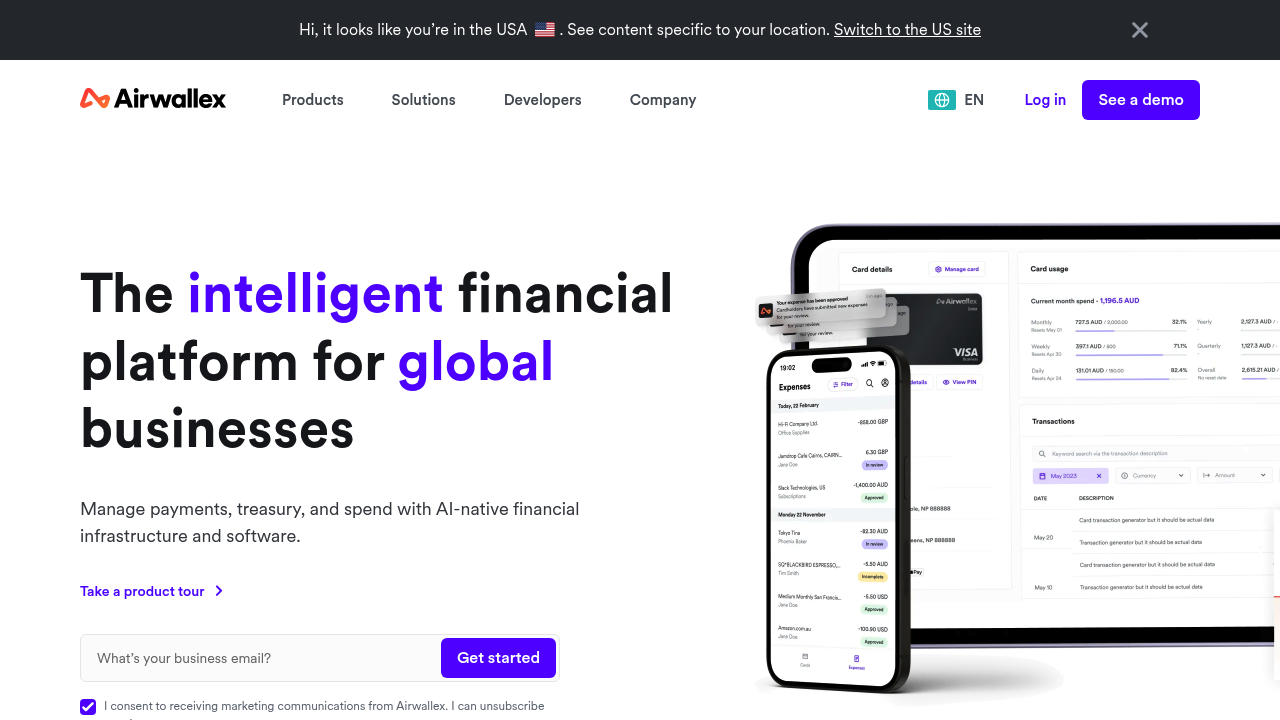
Specific things Airwallex does: open local-currency business accounts in multiple countries (allowing you to receive payments in USD, EUR, GBP, AUD, HKD, SGD, and others without conversion), send payments to 150+ countries in 60+ currencies at competitive FX rates, issue Visa corporate cards to employees with built-in spend controls and real-time expense tracking, manage and approve employee expenses, and connect directly to accounting tools like Xero and QuickBooks to sync transactions and reconcile automatically.
To be clear about what it doesn't do: Airwallex doesn't replace your accounting software. It doesn't do invoicing, payroll, tax filing, or double-entry bookkeeping. It's financial infrastructure that feeds into your accounting system. Think of it as the pipes that move money — your accounting software is where the books live. See how Airwallex handles multi-currency payments →
Who It's Built For
Airwallex is built for businesses that operate across borders. This includes e-commerce companies selling in multiple countries, SaaS businesses with international customers and foreign-currency revenue, professional services firms paying international contractors, import/export businesses with overseas suppliers, and startups that need a global financial account before they can open local bank accounts everywhere they operate.
The minimum viable Airwallex customer is a business doing at least some volume of international payments — either paying suppliers in foreign currencies, receiving revenue in non-domestic currencies, or both. If 100% of your revenue and expenses are in a single currency and all your vendors and customers are domestic, Airwallex's unique value is minimal for you. A domestic bill pay tool like Melio or a simple bank account is more appropriate.
Airwallex is particularly strong for growth-stage startups and scaleups that are expanding internationally and need financial infrastructure that moves faster than traditional banking. Opening a UK bank account as a non-UK company typically takes weeks. Airwallex accounts can be set up in days. For a startup that just closed a round and needs to start paying international contractors immediately, that speed is genuinely valuable.
It's NOT a replacement for your accounting software. It pairs with Xero, QuickBooks, or whatever system you use to keep your books — it's the payment and FX layer, not the bookkeeping layer. Make sure you understand that distinction before evaluating it.
Key Features That Stand Out
- Multi-currency global accounts: Hold balances in 20+ currencies in a single platform. Receive payments in local currency from customers or marketplaces without forced conversion. Pay suppliers in their local currency directly from your balance.
- Competitive FX rates: Airwallex offers exchange rates notably better than traditional bank wire rates — typically within 0.5–1% of interbank rates, versus 2–5% markups common with banks. For businesses moving significant sums across currencies, this difference compounds quickly.
- Corporate cards with spend controls: Issue virtual or physical Visa cards to employees with pre-set spending limits, merchant category restrictions, and real-time visibility. Expenses sync to your accounting software automatically, eliminating manual expense reports for card spend.
- Xero and QuickBooks integration: Transactions from your Airwallex accounts and cards sync to your accounting software, with currency conversion data, fees, and FX gains/losses captured accurately for reconciliation.
- API and embedded finance capabilities: Airwallex offers a robust API for businesses that want to embed payment or FX capabilities into their own products. This goes well beyond what most SMB-focused payment tools offer and is a reason some fintech startups and platforms choose Airwallex as infrastructure rather than just an account.
The FX cost savings are worth quantifying for perspective. A business that moves $50,000 per month internationally and is paying a 3% bank markup on FX is spending $1,500 per month — $18,000 per year — on currency conversion alone. At 0.5% on Airwallex, that same volume costs $250 per month, or $3,000 per year. The difference funds a part-time contractor. At $200,000/month in FX volume, the savings are over $60,000 per year. For businesses with meaningful cross-border cash flows, the ROI on switching from traditional banking FX to Airwallex is almost always immediate.
The corporate card product has also matured significantly. Early versions were primarily virtual; now physical cards are available in most markets, and the spend control granularity (per-card limits, per-merchant-category rules, real-time notifications, receipt capture via mobile) is competitive with specialist corporate card tools like Brex or Ramp for international use cases. Calculate your FX savings with Airwallex →
Pricing Breakdown
Airwallex's pricing model has evolved toward a tiered structure that includes a base plan for small businesses and premium plans for higher-volume users. Based on their general approach: expect a free or low-cost base tier that covers account opening and basic transfers, a growth tier with lower FX fees and more features, and an enterprise tier with custom pricing for high-volume or embedded-finance use cases. FX margins are a key variable — Airwallex charges a spread on currency conversions rather than flat fees on many transfers. Verify current pricing at airwallex.com as it varies by region and is updated periodically.
| Tier | Best For | What You Get |
|---|
| Starter / Free | Small businesses and startups | Multi-currency accounts, basic international transfers, virtual cards |
| Growth (paid) | Scaleups with regular FX volume | Lower FX margins, physical cards, higher limits, Xero/QBO sync, expense management |
| Enterprise | High-volume businesses and embedded finance | Custom FX rates, dedicated support, API access, white-label options |
Airwallex vs. the Competition
Airwallex's main competitors are Wise Business (formerly TransferWise for Business) and, for US-centric corporate cards, Brex and Ramp. The comparison is worth being specific about.
Wise Business is probably Airwallex's closest competitor in the SMB international payments space. Wise is strong on transparent FX pricing, has a massive transfer network, and is excellent for straightforward international payments at low cost. Where Airwallex differentiates: it's more of a full financial platform (local accounts, cards, expenses, API) versus Wise's core focus on transfer infrastructure. For businesses that need more than just cheap transfers — full multi-currency accounts, corporate cards, expense management, developer API — Airwallex is the more complete solution. For businesses that primarily need to send money internationally as cheaply as possible, Wise is worth comparing directly.
Against Brex and Ramp (US-focused corporate card tools), Airwallex's advantage is its global infrastructure. Brex and Ramp are excellent products but heavily US-centric. A company with global headcount needs corporate cards that work seamlessly in multiple countries and currencies — Airwallex handles that better than either of them currently.
One honest limitation of Airwallex: it's not ideal as the only financial account for a micro-business doing all-domestic transactions. The product's depth adds complexity that a simple domestic bank account or Melio setup doesn't have. It's genuinely built for cross-border operations, and if your business doesn't have them, you're buying infrastructure you won't use.
Want a deeper dive? Compare Airwallex vs. Wise Business in our upcoming head-to-head guide.
Emerging Trends Shaping Accounting Software in 2026
Three global trends are reshaping how platforms like Airwallex evolve and compete.
First: real-time cross-border payments are becoming a baseline expectation. ISO 20022 adoption, expanded SWIFT GPI coverage, and regional instant payment schemes (UPI in India, PIX in Brazil, PayTo in Australia, FedNow in the US) are all moving toward a world where sending money internationally takes seconds, not days. Airwallex is actively building on these rails, and the gap between "instant domestic" and "slow international" is narrowing fast. For businesses, this means the FX platform you choose today should be actively investing in real-time rails — not just a legacy SWIFT-based transfer tool with a better interface.
Second: embedded finance is becoming a competitive moat. Airwallex's API-first architecture positions it as infrastructure for other businesses to build financial products on top of. This embedded finance model — where a non-financial company integrates payments, FX, or card issuance into their own platform — is one of the fastest-growing areas in fintech. Airwallex's investment in this layer is strategically important; it expands the market beyond direct business users to platform customers who embed Airwallex capabilities in their own products.
Third: multi-currency cash management is a strategic finance skill, not just a treasury function. Businesses with global operations are increasingly treating FX as an active management question — when to convert, when to hold, how to hedge — rather than a passive cost of doing business. Platforms like Airwallex that give CFOs and founders real visibility into multi-currency positions are enabling better decisions. Tools that just move money without giving visibility into FX exposure are getting replaced.
For businesses operating globally, Airwallex isn't a nice-to-have — it's a foundational infrastructure upgrade. The question in 2026 isn't whether you need a platform like this, but whether Airwallex specifically is the right fit for your geography and volume. For most cross-border businesses in the mid-market, it is.
How to Get Started
- Apply for an account at airwallex.com — business verification is required and typically takes 1–3 business days.
- Fund your account by transferring from your existing bank account into your Airwallex wallet in your home currency.
- Connect your accounting software (Xero or QuickBooks) so transactions sync automatically from day one.
- Issue your first corporate cards to team members who need them, set spend controls, and process your first international payment to see the FX savings in real time.
Frequently Asked Questions
Is Airwallex good for small businesses?
Yes, if your small business has international payments — but less so if you're entirely domestic. Airwallex's value is in its global infrastructure: multi-currency accounts, competitive FX, and international transfers. For domestic-only businesses, simpler tools are a better fit.
Does Airwallex integrate with QuickBooks?
Yes, Airwallex integrates with both QuickBooks and Xero. Transactions, FX conversions, and card expenses sync automatically to your accounting software for reconciliation.
What does Airwallex cost?
Airwallex charges primarily through FX margins rather than flat transfer fees on most transactions. There are tiered plan fees for premium features. Check airwallex.com for current regional pricing — it varies by country.
Is there a free trial?
Airwallex offers a free account tier with basic features. You can open an account and start processing transfers without committing to a paid plan, though higher-volume features require a paid tier.
A calculator widget comparing your current bank's FX fees against Airwallex rates — using your typical monthly transfer volume — would convert readers at high rates. Consider building one for this page.
If you're paying bank rates on international transfers, you're leaving money on the table every month. Open your Airwallex account and see your FX savings before your next transfer →